
The Five Element Breath Practice
Nine slow breaths into each of five organs, once a week, is a simple way to keep energy moving through the body-mind and ease the stuck, heavy feeling that builds up when you're always on.
Why stagnation matters
If you're a giver, you know the feeling. You keep going, you keep holding it together, and somewhere along the way things stop moving. Your shoulders set like concrete. Your jaw stays clenched. Your thoughts loop. You feel flat, or wired, or both.
Traditional Chinese Medicine (TCM) has a name for this: stagnation. Energy, or qi, is meant to flow. When it pools in one place, the body and the emotions tend to feel it together.
This practice is one small, repeatable way to bring movement back. It takes about ten minutes. You can do it sitting or lying down, and you don't need anything but your breath and a little attention.
The five elements, in plain language
TCM describes the body through five elements: Wood, Fire, Earth, Metal and Water. Each one is linked with an organ, an emotion, a colour and a sound.
The idea is that the organs and emotions aren't separate. How you feel and how your body is working are read together. So when one emotion gets stuck, the organ linked to it is where the practice invites you to turn your attention.
Here is the whole map in one place.
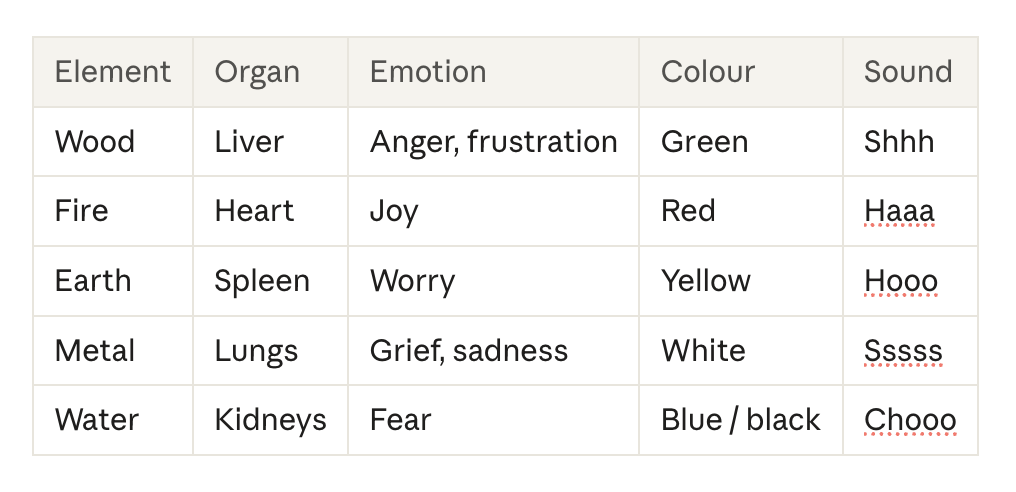
A quick honest note. Sources differ on the exact sounds and some of the colours, and the version here is the one commonly taught in qigong's "healing sounds" tradition. If your teacher uses a slightly different sound, trust that one. This is a traditional practice for body awareness and settling, not a medical treatment.
How the practice works
Once a week, you take nine breaths into each organ, one organ at a time. Same order each time.
- Get comfortable. Sit or lie down somewhere you won't be interrupted. Let your shoulders drop.
- Place one hand over the organ. Feel the warmth of your palm.
- Breathe in slowly through your nose. Picture the organ's colour softly filling that area.
- Breathe out through your mouth, making the organ's sound quietly, with a long exhale. Think of the emotion and let it travel out with the breath.
- Repeat for nine breaths. Then rest for a moment and notice what's changed.
- Move on to the next organ.
Keep the exhale longer than the inhale. Slow, extended exhales tend to settle the body, and that's what you're after here. Nothing forced. Nothing perfect.
The five organs, one by one
1. Liver (Wood): green, "shhh"
The emotion is anger, including irritation and frustration. Place your hand on the right side, just under your ribs. Breathe in a soft green. Exhale with a long, quiet shhh. If you're holding resentment or feeling tense and boxed in, this is the one to linger on.
2. Heart (Fire): red, "haaa"
The emotion is joy, which in TCM includes overexcitement as well as a lack of it. Place your hand in the centre of your chest, slightly left. Breathe in a warm red. Exhale with an open haaa, like a soft sigh.
3. Spleen (Earth): yellow, "hooo"
The emotion is worry, the overthinking and mental looping so many of us carry. Place your hand on the upper left side of your abdomen, under the ribs. Breathe in a warm yellow, like sunlight. Exhale with a low, long hooo, as if you're blowing across the top of a bottle. Let the thoughts go out with the sound.
4. Lungs (Metal): white, "sssss"
The emotion is grief and sadness. Place your hands on the upper chest, below the collarbones. Breathe in a clean white light. Exhale with a gentle, steady sssss, like air slowly leaving a tyre. Go easy here. Grief often needs gentleness, not force.
5. Kidneys (Water): blue or black, "chooo"
The emotion is fear. Place your hands on your lower back, either side of the spine at waist height. Breathe in deep, cool blue. Exhale with a soft chooo, letting your lower back soften and widen.
Your weekly practice, step by step
Pick one day a week and keep it the same. Sunday evening or Monday morning works well. Allow about ten minutes.
- Settle. Sit or lie down. Feel your weight being held. Take two natural breaths before you start.
- Liver. Right hand under the right ribs. Breathe in green, exhale shhh. Nine breaths.
- Heart. Hand on the centre of the chest. Breathe in red, exhale haaa. Nine breaths.
- Spleen. Hand on the upper left abdomen. Breathe in yellow, exhale hooo. Nine breaths.
- Lungs. Hands below the collarbones. Breathe in white, exhale sssss. Nine breaths.
- Kidneys. Hands on the lower back. Breathe in blue, exhale chooo. Nine breaths.
- Close. Rest both hands on your belly. Take three natural breaths. Notice where you feel warmer, softer or steadier.
A few gentle notes
If an organ feels flat, or you feel nothing at all, that's fine. Keep going. Awareness builds with repetition.
If an emotion rises, slow down and let the exhale be a little longer. You're not trying to push anything away. You're giving it somewhere to move.
If you have a medical condition, are pregnant, or find that breath work brings up anything difficult, check in with your practitioner first and go at your own pace. This practice supports body awareness and settling. It isn't a substitute for medical care.
Start with this week. Nine breaths each. See what you notice.